How Casino Brochures Describe Tuy Phong
Learn how to read casino brochure language in Tuy Phong, separate named venue details from promotional claims, and describe what the wording leaves unclear.
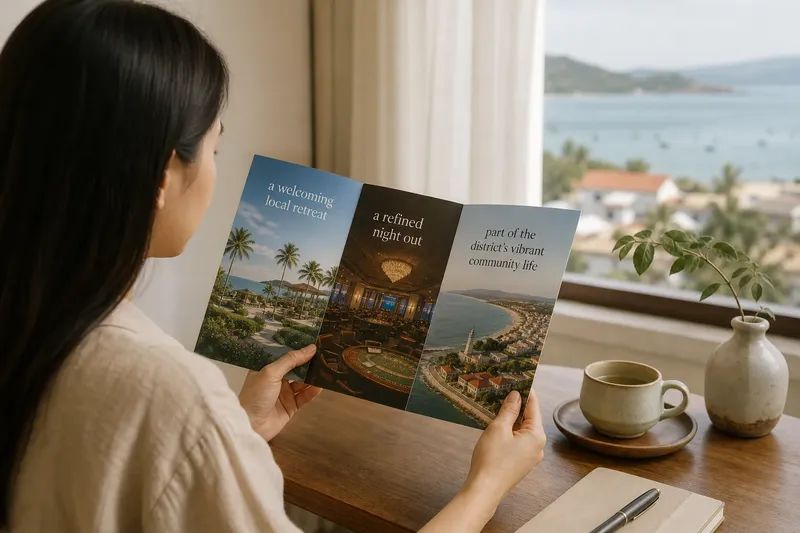
At a guesthouse in Tuy Phong, a visitor opens a casino brochure beside a cup of tea. The cover calls the venue “a lively local gathering place”; another panel describes “an elegant entertainment destination”. Casino brochure language gives the visitor an impression before explaining what the venue offers.
A phrase can set a mood, make a claim, or do both. To read it closely, separate the words on the page from the details they support and the questions they leave unanswered.
Read the claim inside a casino brochure
Labels often carry several meanings in a few words. “Family-friendly” suggests an audience and atmosphere. “Premium” signals status but does not name the features behind it. “Local” connects a venue with its surroundings without saying whether that means location, staff, customers, design or ownership.
Find the main noun, then look at the words around it. In “traditional coastal entertainment”, the noun is “entertainment”. “Traditional” and “coastal” give it an identity, but the phrase does not name a tradition or explain the activity.
Promotional wording is not automatically deceptive. A brochure may use a phrase to establish a tone. Readers can recognise that tone without treating it as evidence for a more specific claim.
Mark the words that imply quality or belonging, then look for the brochure’s named details.
Notice how brochures connect a venue with community life
Imagine a fictional casino brochure for a fictional venue in Tuy Phong. Its cover says “a welcoming local retreat”, a panel promises “a refined night out”, and the back calls it “part of the district’s vibrant community life”. These phrases are invented; they describe no known venue or local practice.
“Welcoming” conveys an impression. It might refer to staff, a shared space or simply the tone of the copy. Without more detail, the reader cannot tell which meaning the brochure intends.
“Local retreat” combines a place-word with an image of escape. “Local” could refer to the venue’s setting, workforce or intended identity. “Retreat” suggests a break from ordinary demands. The wording leaves both terms open.
“Refined night out” makes a judgement about style. It might point to décor, service or dress, but the phrase names none of these. It also presents one kind of leisure as refined without explaining the basis for that judgement.
“Part of the district’s vibrant community life” places the venue inside a collective story. “Part of” could mean its location, an event, a partnership or a claim of belonging. The brochure needs to identify the relationship before a reader can describe it more precisely.
For this invented brochure, a reader could write two notes: “The brochure presents the venue as welcoming, refined and connected with the district”; “It does not say who the labels address or what community connection they refer to.” The first records the wording. The second marks its limits without turning either into a claim about actual residents.
Keep the brochure’s exact words distinct from what you infer from them.
Separate a Tuy Phong location from a claim of belonging
A venue’s location in Tuy Phong does not, by itself, explain the place. Coastal imagery may establish a visual theme without describing local history. “Heritage” may evoke memory while leaving unclear whose memory or which practices the brochure means.
Compare “near the coast” with “rooted in coastal tradition”. The first describes a location. The second suggests cultural inheritance and raises specific questions: which tradition, whose account, and what feature of the venue reflects it?
“In Tuy Phong” tells a reader where the brochure places the venue. “A celebration of Tuy Phong” makes a broader claim about representation. It might refer to photographs, food, language, design or mood. Unless the brochure names the connection, the slogan cannot stand in for a fuller account of the place.
A named design feature, event or service gives readers something specific to consider. A sweeping description may provide atmosphere without explaining its connection to Tuy Phong.
What do casino brochure labels mean?
What does “premium” tell a reader?
“Premium” signals a higher-status offer but does not say what is included or how the label is defined. Look for named features instead of assuming the word applies to every part of a visitor’s experience.
Does “local” mean locally owned?
Not necessarily. “Local” might refer to location, staff, customers, ingredients, design or intended identity. If the copy does not clarify the meaning, report the word without assigning it one.
Is “welcoming” the same as “open to everyone”?
No. “Welcoming” describes a tone, while “open to everyone” sounds like a claim about access. Neither phrase alone explains entry conditions or facilities, so check the practical information when those details matter.
What does “community favourite” establish?
By itself, it establishes that the brochure uses a promotional label. It does not identify who visits the venue or describe the views of a whole community.
Check the details before repeating a brochure claim
Read a broad label beside the specific information that accompanies it. A named programme, service or feature can make the intended meaning clearer, but it does not automatically support a wider claim. The location of the wording matters too: a cover slogan may set a mood, while an information panel may describe arrangements.
Pay attention to verbs. “Hosts a community event” points to an activity. “Supports community life” could mean several things. If the brochure does not explain what kind of support it means, keep that uncertainty visible in your description.
Photographs can add context but cannot settle a broad claim. A picture of a decorated room may help explain “elegant”; it cannot establish who feels welcome or whether the venue represents the district.
- Check “local”. If the brochure names location, ownership, staff or customers, describe that connection. If it does not, attribute the word to the brochure and do not guess its meaning.
- Check “community”. If the copy names a group or activity, identify it. If it names neither, do not present the phrase as a claim about all residents.
- Check “welcoming”. If the brochure names a service or access detail, report that detail. If it does not, describe “welcoming” as the brochure’s tone, not as an experience shared by every visitor.
- Check “premium”. If a specific feature appears beside the label, name that feature. If none does, attribute “premium” to the brochure rather than treating it as a defined standard.
- Check “heritage”. If the text identifies a practice, memory or source, describe the stated connection. If it does not, avoid presenting the venue as a representative of local history.
- Check the photograph’s caption. If it explains the image’s relevance, report the caption as the brochure’s claim. If there is no explanation, describe only what the image visibly depicts.
Use the named detail to set the limits of the larger claim.
Carry brochure wording into conversation accurately
A brochure phrase can move from the page into a visitor’s conversation, a guide’s description or a caption. Repeating it without attribution may make a promotional claim sound like an established description.
Compare “The brochure calls the venue a local retreat” with “The venue is a local retreat”. The first identifies the source; the second adopts its wording. That distinction helps a reader tell a business’s self-description from an independent account.
For the invented brochure above, a careful description would be: “Its brochure calls the venue welcoming and connected with community life, but does not explain who those labels refer to.” This reports both the impression and the information missing from the copy.
If a brochure invokes Tuy Phong’s identity or traditions, quote the exact phrase when its wording matters and say who used it. In your own description, rely on details you can identify rather than repeating a broad label as fact.
Casino brochure language is clearest when readers can see what is claimed and who made the claim. A useful final distinction is simple: report a slogan as a slogan, and let named details—not an attractive phrase—show how far the description can go.